Best Cream Charger Suppliers for Foodservice Distributors: Criteria for Vetting Overseas Manufacturers matters because readers need a clear, practical answer to best cream chargers. For a foodservice distributor, a charger order is not a simple commodity purchase. The product has to match the gas inside it, the dispenser at each customer site, and the paperwork that proves what was shipped. A mistake at any one of those points becomes a service failure for the end customer and a credibility problem for the distributor. This article breaks the topic into How to Choose: Gas Type, Fitting, and Documentation Before Brand, Furrycream 8g N2O Whipping Chargers: Direct-Manufacturer Bulk Supply, Reg so the reader can move from understanding to decision-making without fluff. The first section explains the checks to run before comparing any supplier. The second applies those checks to one direct-manufacturer option. The third compares distributor and direct purchasing through a worked example and a quote worksheet. Read them in order, because each section assumes the checks in the one before it have been done.
How to Choose: Gas Type, Fitting, and Documentation Before Brand
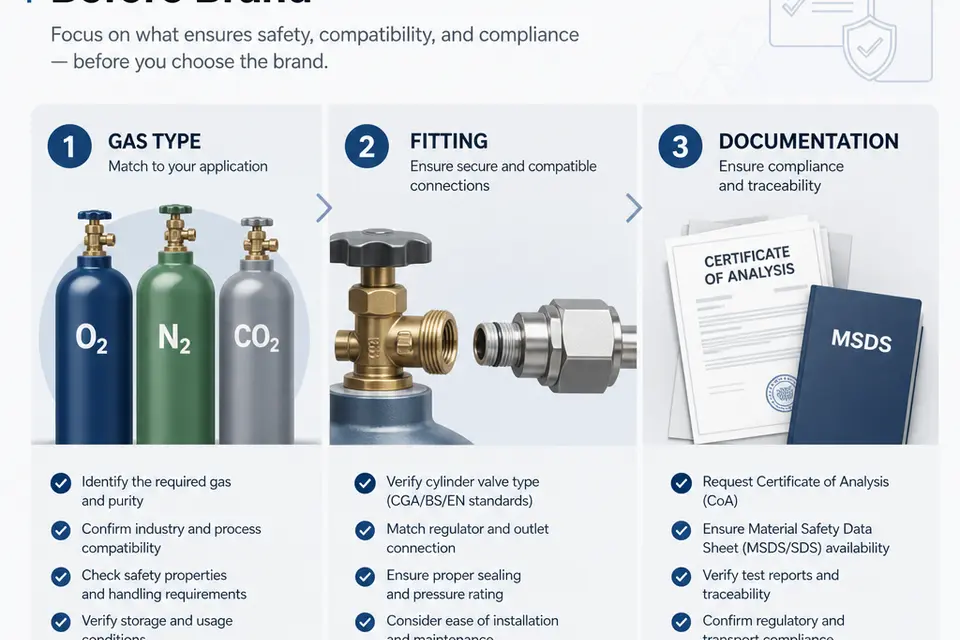
Illustration for How to Choose: Gas Type, Fitting, and Documentation Before Brand
Short answer: Choose the supplier that matches your gas type, fits every dispenser you own, and proves purity with lot-level documents. Brand recognition comes last. A well-known name that ships the wrong gas, or can't show a lot-specific certificate, costs more than a plain-label supplier with clean paperwork.
Foodservice distributors face a particular version of this problem. You are not buying only for your own kitchen. You are passing product to customers who will each run it through their own equipment. Any mismatch becomes your customer's service failure and your credibility problem. That is why the checks below come before price, and why brand is treated as the last filter rather than the first.
Work through three checks in order before you compare prices: (1) confirm the gas type, (2) confirm cylinder size and threading for each dispenser, (3) confirm the supplier can provide a certificate of analysis (CoA) and traceable lot records.
The order matters. Gas type eliminates the wrong products outright. Fitting then narrows the list to products that physically work in your equipment. Documentation decides whether the remaining candidates can be approved for sale. Price only enters once all three filters have been passed. Comparing prices first wastes time, because you will end up discarding quotes that were never usable.
Step 1: N2O Whipping Versus N2 Nitro: Not Interchangeable
Whipping chargers hold nitrous oxide (N2O). Nitro coffee cartridges hold nitrogen (N2). They are not substitutes.
Buyers mix these up often. Pixelfy's title says "Nitrogen Cream Chargers," but its product list includes N2O whippers alongside an ICO N2 nitro coffee cartridge. Threads on r/Baking and r/AskCulinary show the same confusion among cooks and buyers. When a title says one thing and a product list says another, the title is not the evidence. The product description, the gas name on the label, and the dispenser manual are the evidence.
The cost of the mistake is real. A wrong gas gives poor texture, can damage dispenser seals, and can ruin a full batch. For a distributor, the cost multiplies because a wrong SKU may already have been shipped to several sites before anyone notices. Write the gas name on every purchase order, and check it against your dispenser manual before the first delivery. Ask the supplier to confirm the gas in writing, not only in a catalog image or a sales conversation.
Step 2: Cylinder Size and Threading Check
Build a list of every dispenser model across all your sites. Then, for each model:
- Find the charger size and thread type in the dispenser manual.
- Find the same specs on the supplier's spec sheet.
- Request a sample and test-fit it before you order by the case.
Keep the comparison in one shared sheet so that purchasing, operations, and site managers review the same data. Record the dispenser model, the charger size, the thread type, the source document for each, and the date you checked. Manuals and spec sheets can disagree or fall out of date, so a physical test-fit is the final check.
A charger that doesn't seat properly leaks gas and wastes product. Multi-site operators often run two or three dispenser models, which means two or three SKUs. Count those SKUs before you negotiate, because each one affects minimum order quantities and pallet tiers. A supplier that offers a good price on one SKU may offer nothing useful for the second or third model your customers actually use.
Step 3: Documentation: What a CoA Should Show
A certificate of analysis should cover the lot you receive, not a generic sheet. Check that it lists:
- The product name and gas type
- A lot or batch number that matches your carton
- The measured purity against the stated limit
- The test method and test date
- The issuing lab or the person who signed it
A CoA is only useful if it can be tied to the product in your hands. Match the lot number printed on the carton to the number on the certificate before the stock goes into inventory. Record that lot number in your receiving log. If a problem appears later, you can then identify which sites or customers received the same lot.
Ask the supplier what "food-grade" means in their spec. Which standard applies? Which test confirms it? If the answer is vague, treat the claim as unproven. A phrase on a product page is a marketing statement. A named standard, a named test, and a document that shows the result are the things you can check.
Certification logos need the same scrutiny. SupremeWhip's site lists CE, FDA, ISO, TUV, NSF, and HACCP claims. NangWizard calls its gas "some of the purest food-grade gas." A logo or adjective on a product page tells you little. Ask which certificate covers this product, which factory it applies to, and whether the certificate number checks out with the issuing body. A certificate that covers a different product line, a different factory, or a different year does not cover the stock you are buying.
Finally, ask for lot traceability. Can the supplier trace each carton back to its production lot, and how quickly can it produce those records on request? A supplier that takes weeks to answer a lot query is hard to rely on when a customer complaint or a quality question arrives.
Furrycream 8g N2O Whipping Chargers: Direct-Manufacturer Bulk Supply
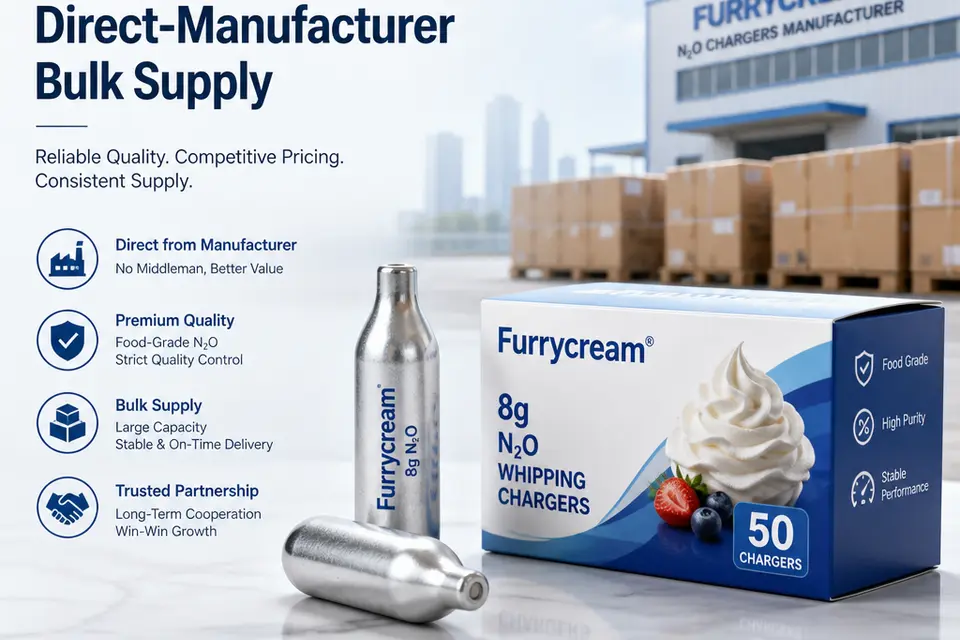
Illustration for Furrycream 8g N2O Whipping Chargers: Direct-Manufacturer Bulk Supply
Short answer: Furrycream 8g N2O whipping chargers fit multi-site operators who reorder on a schedule and want factory-level documentation from one supplier. They fit a single café buying a few cases a month much less well. Before you order, confirm the gas, the fitting, and the paperwork match your dispensers.
Furrycream 8g N2O Whipping Chargers (Direct from Manufacturer)
Best for: Multi-location operators buying on a recurring schedule.
What you get
- 8g food-grade N2O in case configurations, listed in the product catalog.
- Certificate of analysis (CoA) and certification documents on request.
- Volume tiers for repeat orders.
- A shorter supply chain. Fewer handoffs mean fewer points where lot traceability can break.
The value of this option depends on how you use it. A direct relationship with the manufacturer means the people who answer your documentation questions are closer to the production record. It also means you hold fewer intermediaries responsible for gaps. The trade-off is that you take on more of the ordering, freight, and import work yourself.
Pros
- A direct documentation trail from the factory to your receiving dock.
- Tier pricing that suits scheduled replenishment.
- One supplier across multiple sites.
Cons
- Minimum order quantities may exceed what a single site uses.
- You must confirm first-order lead time and import handling before committing.
Rating
- 4.5/5 for multi-location operators.
- 3/5 for a single café needing a few cases per month.
The rating reflects fit, not a universal verdict. A multi-location group with steady demand gets more from tier pricing and a single documentation trail. A single café gets less from the same terms because the minimum order is harder to use before stock ages or storage becomes a problem.
Ask a Better Question Than "Which Brand Is Best?"
Procurement teams often compare brands first. A brand name does not tell you which gas sits inside the cylinder, or whether it fits your dispenser. The more useful question is: which gas, fitting, and documentation match my dispensers and food-safety requirements?
Buyer confusion shows up in public forums. Threads on r/Baking and r/AskCulinary show people unsure what these products are and how they work. Pixelfy's guide is titled "Nitrogen Cream Chargers," but its product list mixes N2O whippers with the ICO N2 nitro coffee cartridge. These products are not interchangeable. Forum threads are not a substitute for a supplier's documents, but they do show that the naming confusion is common enough to plan around.
Some might argue that a well-known brand is a shortcut to quality. However, a brand does not confirm the gas, the thread, or the lot paperwork. Those three checks do. A brand can be a useful reference point for reputation or support, but it should be treated as a starting point for verification, not the verification itself.
A Three-Step Decision Framework
1. Confirm the gas type.
- N2O is for whipped cream applications.
- N2 is for nitro beverage dispensing.
- Ordering the wrong gas wastes product and can leave a dispenser unusable.
Check the dispenser manual, then match the gas named there against the SKU description. Ask the supplier to state the gas in writing on the quote. If the quote, the carton, and the CoA do not name the same gas, stop and resolve the discrepancy before ordering.
2. Confirm cylinder size and threading against each dispenser model.
- List every dispenser model at every site.
- Match each model against the 8g spec and fitting in the product listing.
- Test one case before you commit to a full-pallet order.
Here is the trade-off. If your minimum order is one case and your sites use two different dispenser models, a fitting mismatch leaves unused stock at each affected site. Confirm the match before the first order, not after the stock arrives. A test case costs far less than a pallet of unusable product sitting in storage.
3. Confirm the supplier can provide a CoA and traceable documentation. Ask these questions before approving the supplier:
- Does each shipment ship with a CoA for that lot?
- Does the lot number on the case match the CoA?
- Who performs the testing, and in what lab?
- Can you send copies of the named certifications, not just logos?
Some suppliers list certifications on their websites. Ask for the documents themselves. Procurement and food-safety teams need the paperwork to approve a supplier, so get it in writing. Store copies with your supplier file so that the documents are available at audit time or when a customer asks.
Implementation Risks to Clear Before You Commit
- Lead time: Confirm first-order lead time in writing. Your first order sets the baseline for every reorder, and it is the number you will be held to when a site runs short.
- Import handling: Ask who clears customs, who pays duties, and who files damage claims. Each answer changes your landed cost and your exposure if a shipment is delayed or damaged.
- Minimum order quantities: Calculate how many months of stock one minimum order covers at each site. If it covers more than a year, the order ties up cash and storage space, and product that sits for a long time is product you must keep track of.
Budget Context
Pricing depends on case count and tier, so get a written quote for your expected volume. Compare the landed cost, meaning product, freight, and duties, against your current distributor. Do not compare unit prices alone. A lower unit price can lose its advantage once freight and import costs are added. Include your internal handling costs as well, such as receiving time, storage, and the cost of any stock that is not used before it is no longer suitable for your plans.
For use-case context on how operators apply these chargers, see the cream chargers application page.
Reg
Short answer: Buy through a distributor when you need small, fast, mixed orders across several sites. Buy direct from a manufacturer when your volume is steady, you can wait several weeks, and you can check quality documents yourself. Many multi-location operators use both: a distributor for buffer stock and a direct quote to benchmark price.
The choice is rarely about which channel is better in general. It is about which channel fits your demand pattern, your cash position, and your tolerance for delay. A channel that is cheap per case can be expensive if it leaves a site without product during service. The sections below set out what each option does well and where it creates risk.
Option 1: Distributor
- Where it wins: Lower minimum order quantities, faster restocking, and one invoice for multiple sites.
- Where it costs you: Higher unit cost at the same volume, and less control over batch origin.
- Check before you sign: Whether they hold stock locally or ship from overseas, and whether they provide a batch-specific certificate of analysis (CoA) on request.
A distributor's advantage is speed and flexibility. You can buy a smaller quantity, respond to a site's sudden need, and consolidate several SKUs on one invoice. The cost is paid in unit price and in reduced visibility into where the product was made and how it was tested. Ask the distributor how it sources its stock, and whether a lot-specific CoA is standard or available only on request.
Option 2: Direct from a manufacturer
- Where it wins: Lower unit prices at case and pallet tiers, and direct access to specs and CoAs.
- Where it costs you: Higher minimum orders, longer lead times, and you manage freight, import paperwork, and duties.
- Check before you sign: Who holds each certificate, whether the manufacturer ships to your country, and what documents come with each shipment.
The direct channel rewards planning. Its lower unit prices only make sense if you can forecast demand well enough to order a pallet without stranding cash or running short. It also puts more administrative work on your side, including freight booking, customs documentation, and duty payments. Those costs belong in the comparison.
Hypothetical example: a four-location restaurant group
The group, its numbers, and the prices below are invented for illustration. They are not a real customer case or market data.
Assume a fictional group with four sites. Each site uses about 2 cases per week. Group demand is 8 cases per week.
Placeholder quotes:
- Distributor: 10-case minimum, $60 per case, 2-day delivery from local stock.
- Direct manufacturer: One pallet minimum (assume 60 cases), $45 per case at pallet tier, 6-week lead time plus freight.
The math:
- A pallet from the manufacturer costs $2,700 (60 × $45). The same 60 cases from the distributor costs $3,600 (60 × $60). That is a $900 difference per pallet.
- At 8 cases per week, one pallet covers about 7.5 weeks of group demand.
- With a 6-week lead time, the group must order before stock drops below 6 weeks of cover, or it runs out.
The example is deliberately simple. It omits freight, duties, and storage costs, which the quote worksheet below asks you to add. It also assumes demand is steady. Real demand moves with the season, menu changes, and local events, so your reorder point should be set with some margin above the bare arithmetic.
The stockout: The group orders one pallet direct and plans to cover the gap with the distributor. Then site 3 runs out of cream chargers during Saturday dinner service. The direct pallet is three weeks out. The site has no local stock, and the distributor's 10-case minimum is more than the site needs for the night. The site either removes dessert items from the menu or buys a smaller lot at a higher rate through the nearest available source.
The lesson: The $900 saving disappears when one site loses a full service. The group needs a buffer, and the buffer needs a supplier who can ship within days. The direct pallet is still a sound choice for the steady base load, but it cannot be the only supply line.
Quote-comparison worksheet
Copy this table and fill in your own quotes. Leave cells blank where a supplier does not provide the information. Do not guess.
| Line item | Distributor quote | Direct quote | Your notes |
|---|---|---|---|
| Minimum order (cases) | |||
| Unit price at minimum order | |||
| Unit price at pallet tier | |||
| Pallet size (cases) | |||
| Lead time (days) | |||
| Freight per order | |||
| Import duties and fees | |||
| Landed cost per case* | |||
| Stock on hand (cases) | |||
| Weekly group usage (cases) | |||
| Weeks of cover** | |||
| Batch CoA provided? (Y/N) | |||
| Certificates listed (name and issuer) | |||
| Gas type confirmed for your dispenser? (Y/N) | |||
| Payment terms | |||
| Estimated cost of one missed service |
- Landed cost per case = (unit price × cases + freight + duties + fees) ÷ cases
Weeks of cover** = stock on hand ÷ weekly group usage. Compare this with the supplier's lead time in weeks. If cover is shorter than lead time, you need a buffer supplier.
Use the worksheet in a fixed order. Fill in the supplier terms first, then your own usage and stock figures, then the documentation rows. Leave the last row for an honest estimate. Many teams skip it, but it is the row that shows whether a cheaper channel is actually cheaper once a service is lost. If two suppliers look close on landed cost, the one with the shorter lead time or the stronger documentation is usually the safer choice.
Implementation risks to check before you approve a supplier
- Lead time versus cover. A cheap pallet means nothing if it arrives after your stock runs out. Calculate weeks of cover before you commit to a direct order.
- Gas type. Confirm the product is the right gas for your equipment. Whipping cream chargers are N2O. Nitro coffee cartridges use N2. These are not interchangeable, and the wrong gas can ruin product and damage equipment. Pixelfy's product listing mixes both, which causes confusion. Check the product type, not just the title.
- "Food-grade" claims. Do not accept the phrase alone. Ask for the batch CoA, read the stated purity and test results, and confirm the certificate names the product you are buying. Ask which lot numbers it covers.
- Substitution rules. Ask what happens when a SKU is out of stock. Some suppliers ship a different gas or size. Write the rule into the purchase order, so that no substitution happens without your written approval.
For a broader product overview, see best cream chargers. For use cases and dispenser fit, see cream chargers.
Conclusion
The strongest article here is the one that stays practical: define the scope clearly, show the tradeoffs, and help the reader choose the next action with confidence. In practice, that means starting with the three checks in the first section: confirm the gas type, confirm the fitting for every dispenser, and confirm the supplier can provide lot-specific documentation. Only then should price enter the decision. The Furrycream section shows how those checks apply to one direct-manufacturer option, including where it fits well and where it does not. The final section shows that the choice between distributor and direct purchasing is a question of demand pattern, lead time, and cash, not a simple ranking of channels. Use the quote worksheet with your own figures, keep a buffer supply line for any site that cannot afford a stockout, and put every agreed gas name, lot number, and substitution rule in writing before the first order is placed.

-
 Hangzhou Luire Technology Co., Ltd.
-
 ROOM 2805 JINZUN TOWER OF ZUNBAO,HANGZHOU,CHINA
-

-

-