How Foodservice Buyers Should Specify a 0.95L Cream Charger Order matters because readers need a clear, practical answer to 0.95L cream charger. This article breaks the topic into Prerequisites for Specifying a 0.95L Cream Charger Order, Map the Complete Chain: Neck Thread, Regulator, and Dispenser, Model Cost per Serving Across 0.95L, 8g, and 640g Formats so the reader can move from understanding to decision-making without fluff.
Prerequisites for Specifying a 0.95L Cream Charger Order
Don’t assume a 0.95L cylinder lowers your cost per serving. Build the baseline first, then run the break-even check below. The switch only pays off when your current format’s cost per serving exceeds the 0.95L cost after you add the new hardware and labor.
Step 1: Gather baseline data (2-3 hours)
- What: Pull your 8g or 640g purchase invoices, and log your dispenser and regulator model numbers.
- Why: Invoices give you a traceable cost per serving that finance can audit.
- How: Record monthly whip volume, portion size, storage space, wash-down routine, and delivery region in a shared spreadsheet.
Step 2: Assign owners Name a procurement lead, kitchen operations manager, finance reviewer, and food safety owner. Each one signs off on their inputs before quotes arrive.
Step 3: Run the break-even check
Break-even monthly servings = (new regulator and dispenser cost + added monthly changeover labor) ÷ (current cost per serving − 0.95L cost per serving)
Count partly used cylinders as waste at each changeover. If your monthly volume falls below the result, stay on your current format.
Common mistake: Teams skip the regulator cost and compare only cylinder prices. Confirm neck thread and regulator fit before ordering, or you strand inventory.
Once your model is complete, compare quotes on the 0.95L cream charger product page.
Map the Complete Chain: Neck Thread, Regulator, and Dispenser
Map the full gas path before you compare cylinder prices. A 0.95L cylinder only saves money if its neck, regulator, and dispenser all work together. One mismatch leaves you with inventory you cannot use, and the return or reorder costs more than the price gap you were chasing.
Buyers asking about 0.95L cylinders on r/NitrousOxide raise the same fit questions. Treat fit as the first filter and price as the second.
Step 1: Record the cylinder neck
- What: The thread type, size, and seal design in the cylinder’s written specification.
- Why: The neck decides which regulators can connect. Thread and seal details also decide whether the connection holds pressure.
- How: Get the spec sheet for the exact 0.95L model. Save it with its document number or revision date.
Step 2: Record the regulator inlet and rated pressure
- What: The inlet connection type and the regulator’s rated pressure.
- Why: A regulator labeled “0.95L” does not guarantee a fit. The inlet must match the neck, and the rating must suit the cylinder.
- How: Ask the supplier for the regulator drawing or a written statement that names compatible cylinder necks.
Step 3: Record the dispenser charger holder
- What: The holder design that seats and pierces the charger.
- Why: A holder built for a different neck or seal can leak or fail to seat.
- How: Confirm compatibility in the dispenser maker’s written documentation. Marketing copy that says “works with cream chargers” does not count.
Compatibility failure matrix
| Mismatch point | Typical failure | Verify before ordering |
|---|---|---|
| Neck thread vs. regulator inlet | Regulator does not thread on, or threads cross | Compare spec sheets, then test-fit one cylinder and one regulator |
| Regulator seal vs. neck | Gas leaks at the connection | Check seal type in writing, then leak-test a sample |
| Regulator rating vs. cylinder | Regulator unsuited to the cylinder’s pressure | Get the rated pressure in writing |
| Dispenser holder vs. cylinder | Charger fails to seat or pierce, or leaks | Test a sample dispenser with the same lot |
| Dispenser vs. regulator | An adapter is needed, adding parts and leak points | Confirm in the manufacturer document that no adapter is needed |
Common mistakes to avoid
- Assuming a “0.95L” label means universal fit.
- Ordering cylinders, regulators, and dispensers from separate suppliers without a tested chain.
- Accepting a verbal “compatible” claim with no document behind it.
**Pro tip:**Ask suppliers for a test-fit video or a sample regulator before committing to a pallet.Set a clear rule: do not release a bulk order until one full chain passes a leak test and a seating test on at least three units. This is a practical threshold, not an industry standard.Plan on one to two hours to gather documents, plus a few days for sample testing.
Once you have a verified chain, compare pricing across cylinders that fit it. You can review the 0.95L cream charger range, or learn more about our team before you request samples.
Model Cost per Serving Across 0.95L, 8g, and 640g Formats
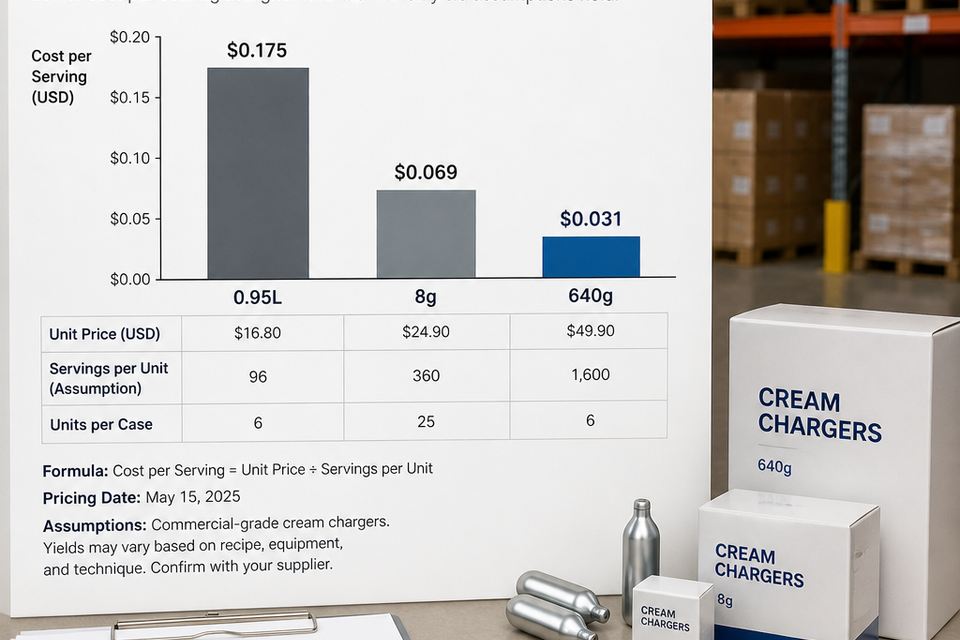
Cost per serving drops as format size increases, but only if your servings-per-unit assumption holds for your volume. Confirm current pricing and yield with your supplier before committing to a bulk order.
The 0.95L format saves money only if its total cost per serving, including capital, labor, and waste, beats your current format on your own volume. A lower price per cylinder does not prove that, and finance will ask for the full number.
Step 1: Pull 12 months of invoices and whip counts
- What: Record total spend and total grams bought for each format you use now, plus the 0.95L.
- Why: Finance trusts actual purchases more than supplier price sheets.
- How: Divide spend by grams to get gas cost per gram. Then count servings per format from your POS or prep logs.
Step 2: Calculate total annual cost per format
Use this formula for each format:
Total annual cost = (gas cost per gram x grams consumed) + amortized regulator and dispenser capital + changeover labor + waste from partially used cylinders
- What: Add all four cost lines.
- Why: Gas price alone hides the cost of equipment, staff time, and leftover gas.
- How: Amortize new equipment over your approved capital horizon. Multiply changeover hours by your loaded labor rate.
Step 3: Calculate the switch saving
Annual switch saving = [(current cost per serving − 0.95L cost per serving) x annual servings] − [new capital amortized per year + changeover hours x loaded labor rate]
If the result is negative or thin, the switch does not pay back on your volume. Some operators argue that fewer refills justify the change on their own. However, refill frequency only matters after the per-serving saving covers the new equipment and retraining.
Common mistake: counting the discount and ignoring waste
A partly used 0.95L cylinder left at shift end or stored between events is gas you already paid for. Track how many cylinders you open but do not empty. Add that waste to the 0.95L cost line before you compare.
Pro tip: set a break-even volume
Calculate the monthly servings needed to pay back the switch within your capital horizon:
Break-even monthly servings = (annualized new capital + annual changeover cost) ÷ (12 x saving per serving)
Show finance this number. If your real monthly volume sits well above it, the case holds. If it sits near it, a slow season can erase the saving.
Supplier verification checklist
Ask every supplier for these five items in writing:
- Food-grade gas purity documentation
- Cylinder pressure rating
- Hydrostatic test dates
- Stamped markings on the cylinder
- CE/PED or DOT/TC approval status
Set pass/fail thresholds from your own insurance policy and local regulatory requirements. Do not borrow thresholds from competitors or forums.
Implementation risks
- Fit: Confirm neck thread, regulator, and dispenser compatibility before ordering. Mismatched parts leave inventory you cannot use.
- Shipping: Ask the supplier for hazmat classification, carrier restrictions, and freight surcharges. Request the SDS, commercial invoice, and HS codes for imports.
Time and effort
Plan one to two days to build the model if invoices are accessible. Allow one to two weeks for supplier responses. These are planning estimates, not benchmarks.
Once your numbers clear the break-even test, review the 0.95L cream charger specifications against your equipment list before you request a quote.
Verify Shipping, Hazmat Classification, and Import Documentation
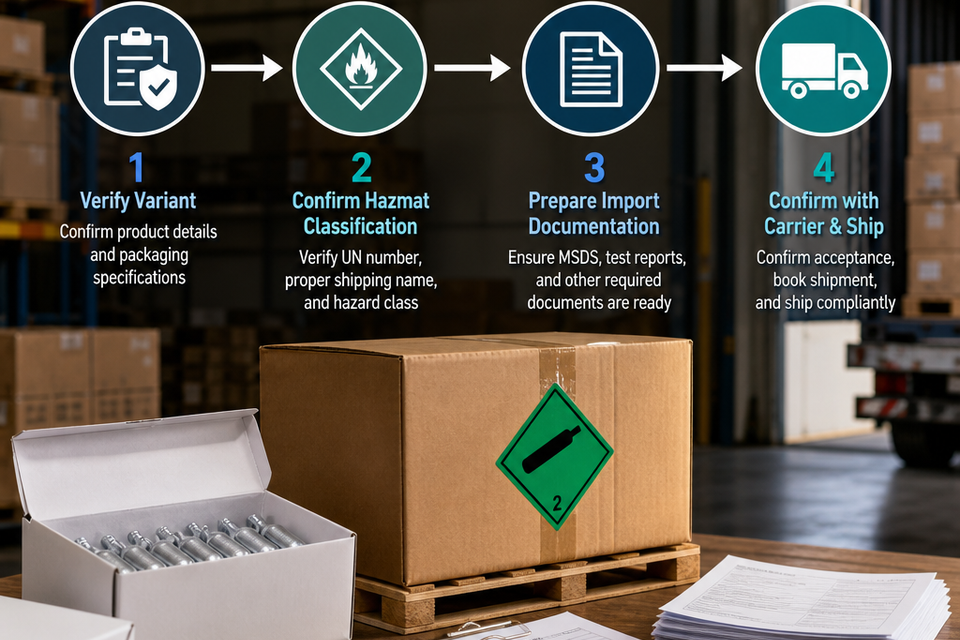
Hazmat compliance for cream chargers is a sequence, not a checklist. A mistake in classification, such as an incorrect UN number, usually surfaces later as a rejected shipment or a customs hold, so verify the classification first and confirm it with your carrier before you ship.
Confirm how the cylinder is classified and shipped before you calculate landed cost. A quote that looks low often leaves out hazmat and carrier surcharges, and those show up later on the invoice.
Step 1: Get the UN number and hazard class in writing
- What: Request the Safety Data Sheet (SDS) and the UN number, hazard class, and any subsidiary risk for the exact cylinder you plan to buy.
- Why: Nitrous oxide is commonly listed as UN1070, Class 2.2. Your supplier’s SDS is the document to verify, not a forum post or a previous order.
- How: Ask the supplier to name the UN number in the quote. If they cannot answer within a day, treat that as a red flag.
Step 2: Check the rules for your shipping lane
- What: Verify the classification against 49 CFR 172.101 for US ground and air shipments. For air freight, check the IATA Dangerous Goods Regulations.
- Why: Carrier policies differ. Some carriers accept pressurized gas only under specific conditions, and some lanes allow ground service only.
- How: Ask the carrier three questions: Do you accept pressurized gas? Is this ground-only? What is the hazmat surcharge per shipment?
Step 3: Assemble the import packet
- What: Prepare a commercial invoice, packing list, SDS, and an HS code confirmed by a customs broker.
- Why: Customs and the broker need these documents to clear the shipment and calculate duties. Missing paperwork delays the cylinders at the border.
- How: Send the SDS and product specs to your broker first. Ask for a written HS code confirmation before you place the order.
Step 4: Build a landed-cost sheet with placeholders
Here is a hypothetical example. Harbor Bistro Group (hypothetical) is a mid-size kitchen that orders 0.95L cylinders by ground freight. Replace every bracketed figure with your own quote:
- Product: [$ per cylinder] x [quantity]
- Hazmat surcharge: [$ per shipment]
- Ground-only or restricted-carrier premium: [$ per shipment]
- Fuel surcharge: [% of freight]
- Duties: [HS rate] x [declared value]
- Brokerage fee: [$ per entry]
- Inland delivery to site: [$ per drop]
- Storage: [$ per cylinder per month] if you hold stock beyond your receiving window
Hypothetical tradeoff: Harbor’s walk-in can hold [N] cylinders safely. A bigger order cuts the number of shipments and the per-shipment hazmat fee. But it also needs more storage. A smaller, frequent order fits the space and raises the total surcharge bill. Model both options before you pick one.
Common mistake to avoid
Accepting a quote that omits hazmat or restricted-carrier charges. If the hazmat surcharge is [$X] per shipment and you ship [N] times a year, the omitted total is [$X x N]. Ask the supplier to list every surcharge in writing before you compare quotes.
Pro tip
Ask whether the supplier participates in a shipper’s responsibility program or an equivalent. Also ask whether they provide a dangerous goods declaration with each shipment. Those two answers tell you whether the supplier handles compliance or leaves it to you.
Effort estimate
Expect a few hours of supplier back-and-forth for the SDS, carrier answers, and quote review. Broker confirmation of the HS code can take a day or more, so start it before your order date.
Before you order, also confirm that the neck thread and regulator match your dispensers. A mismatch leaves cylinders you cannot use. You can review the 0.95L cream charger options and compare specs against your current equipment.
Qualify the Supplier with a Documentation Checklist

Before ordering, confirm each of these four document groups from the supplier. Missing certificates for pressure-equipment conformity, food-grade status, or dangerous-goods classification are the most common reasons a shipment is rejected at customs or fails a buyer’s audit.
Don’t approve a supplier until they send verifiable documents for every claim. “Food-grade” and “compliant” are marketing terms until a certificate backs them up. Your insurer and inspector will ask for that certificate first.
Step 1: Request the gas purity certificate
- What: A certificate of analysis (CoA) showing purity and impurity limits for the lot you will receive.
- Why: Purity claims without a lot-level CoA cannot be traced to your shipment.
- How: Ask for the certificate number, issuing body, and issue date. Confirm the lot number matches the cylinders on your pallet.
Step 2: Confirm pressure rating and design standard
- What: The rated working pressure and the named design standard.
- Why: “Industry standard” tells you nothing. A named standard lets you check the claim.
- How: Ask the supplier to name the standard in writing. Compare it against the regional approval in Step 5.
Step 3: Check the hydrostatic test record
- What: The most recent test date and the retest interval.
- Why: An expired test date can block a shipment or a storage inspection.
- How: Calculate the next due date yourself. Do not trust the supplier’s arithmetic.
Step 4: Match the stamped markings
- What: Serial number, test date, and manufacturer mark stamped on the cylinder.
- How: Photograph a sample cylinder from the shipment. Match the serial and test date to the paperwork.
Step 5: Confirm regional approval
- For EU markets: CE marking under PED 2014/68/EU.
- For North America: DOT or TC markings.
Checklist template
| Document requested | Date received | Certificate number | Verifier | Pass/fail |
|---|---|---|---|---|
| Gas CoA (purity, impurity limits) | ||||
| Pressure rating and design standard | ||||
| Hydrostatic test record and interval | ||||
| Marking photos (serial, test date, mfr mark) | ||||
| CE/PED or DOT/TC approval | ||||
| SDS | ||||
| Commercial invoice with HS code |
Common mistake: Accepting a PDF without checking the certificate number, issuing body, and date. Expired or mismatched documents are a common gap. Some suppliers send a certificate for a different lot than the one they ship.
Pro tip: Compare the supplier’s disclosure depth against the manufacturing and quality details on Furrycream’s about page. If a supplier shares less detail than that, expect thinner documents too.
Worked example (hypothetical): Assume a mid-size kitchen, labeled here as a hypothetical buyer, imports bulk 0.95L cylinders by pallet. Every figure below is a placeholder to replace with your own quotes:
- Ex-works price per cylinder: [$X]
- Freight per pallet, including hazmat surcharge: [$Y]
- Duty at the HS code confirmed on the invoice: [$Z]
- On-site storage cost per cylinder, based on your ventilation and segregation limits: [$W]
Landed cost per cylinder equals the sum of those four items, divided across the cylinders on the pallet. A carrier that accepts the load only on a restricted or ground-only basis raises the freight line. A storage limit that caps how many cylinders you can hold forces smaller, more frequent orders. Each extra shipment adds another hazmat surcharge.
Implementation risks
- Documents expire between quote and delivery. Ask for the test record dated within your order window.
- Carriers may refuse hazmat shipments that lack a complete SDS. Confirm carrier acceptance before you pay.
- Suppliers may ship a different lot than the one on the CoA. Check the lot number at receiving.
Effort estimate: Collecting documents takes one to two weeks. Verifying them takes two to three hours per supplier.
Next action: Send this checklist to two or three suppliers with a response deadline. Reject any supplier that sends incomplete files. When documents pass, review the 0.95L cream charger range and request a quote.
Weigh Carbon Steel Against Alternative Cylinder Materials
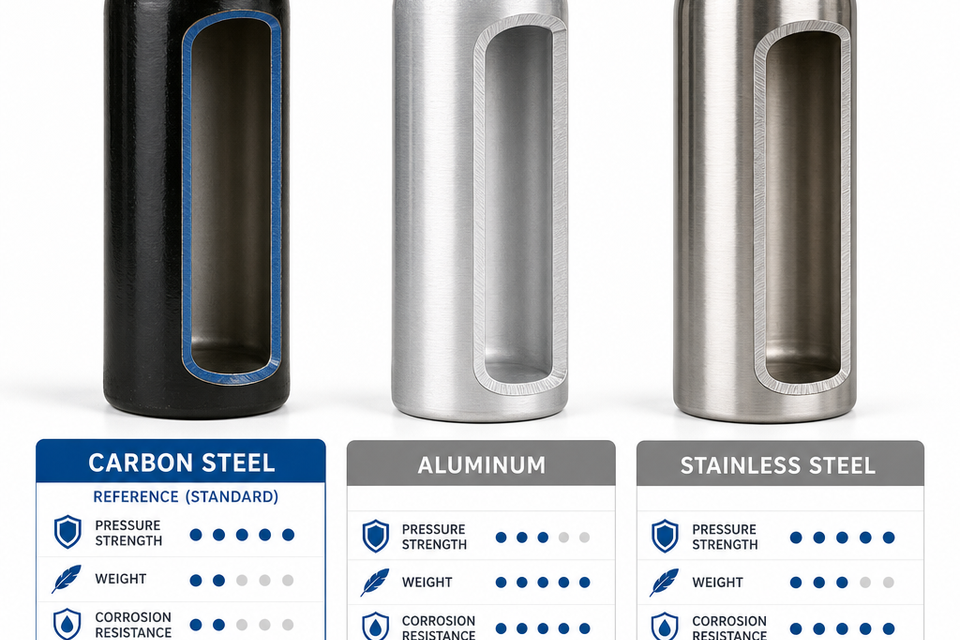
Carbon steel is the standard for 0.95L nitrous oxide cylinders because it combines high pressure strength with low material cost. Its trade-offs are greater weight and a need for corrosion protection, which aluminum and stainless steel avoid at a higher price.
Carbon steel is a good fit only when your storage humidity, wash-down routine, and handling setup match what the material tolerates. Check those three factors before you compare prices.
Hypothetical scenario (all figures are placeholders): A mid-size kitchen orders 0.95L cylinders in bulk and stores them in a humid back room near the dish area. The manager compares a carbon steel quote with a lower-priced alternative. The decision grid below shows what to check.
| Factor | Ask | Carbon steel fits when |
|---|---|---|
| Humidity exposure | Is storage damp or unventilated? | Storage stays dry and ventilated |
| Wash-down frequency | How often do cylinders get washed? | Washing is rare, or the coating is confirmed compatible with your chemicals |
| Handling staff | Who moves cases, and how often? | Full-cylinder weight fits your lifting policy |
| Inspection schedule | Who checks corrosion, and how often? | Your team can check the coating on a fixed interval |
Steps to take:
- Log your exposure (about 2 hours). Record humidity and wash-down events for two weeks. Corrosion risk depends on real conditions, not on the spec sheet.
- Request the coating spec in writing (1 to 3 days). Ask for the material grade, coating type, and chemical compatibility. Confirm it against your sanitizer and degreaser. Visit our 0.95L cream charger page to start the request.
- Weigh a full cylinder. Record the placeholder weight of [X kg] and calculate the load per case for your staff.
- Tie inspections to your log. Shorten the interval for high-exposure storage.
Landed cost for the scenario: Landed cost equals product price, plus freight [placeholder], plus hazmat surcharge [placeholder], plus duties and fees [placeholder], plus storage [placeholder]. Confirm hazmat classification under DOT or IATA rules first. Some carriers restrict or limit ground-only shipments. Your paperwork needs the SDS, a commercial invoice, and the HS code.
Common mistake: Choosing on unit price. If corrosion retires cylinders early, the cheaper unit can cost more per served portion.
Pro tip: File the material and coating spec with your inspection records. When a cylinder fails, you can show what it was built to resist.
Score Suppliers on a Side-by-Side Grid and Decide
Score every supplier on the same weighted grid, then record one decision that procurement, operations, and finance all sign. A shared grid keeps the choice from becoming a debate over the lowest unit price.
Step 1: Set weights before quotes arrive (about half a day)
- What: Weight four criteria: fit verification, landed cost per serving, compliance paperwork, and delivery terms.
- Why: Weights set in advance stop you from favoring the first quote that looks good.
- How: Fit verification means confirming the cylinder, regulator, and dispenser work as one set. Example weights for a hypothetical kitchen: fit 25%, landed cost 40%, paperwork 20%, delivery 15%.
Step 2: Calculate landed cost per serving (1 day)
- What: Add every cost to the unit price, then divide by servings per cylinder.
- Why: Freight and handling can change which supplier is cheapest.
- How: This is a hypothetical kitchen ordering bulk 0.95L cylinders. Replace every figure with your own quote:Unit price: [placeholder]Hazmat freight surcharge: [placeholder]Ground-only or restricted-carrier fee: [placeholder]Customs duty and broker fee: [placeholder]On-site storage cost: [placeholder]Servings per cylinder: [placeholder]
Tradeoff: A supplier with a lower unit price can cost more per serving after surcharges. Model both before you choose.
Step 3: Collect the paperwork (1-2 weeks, mostly waiting)
- What: Request the SDS, commercial invoice, HS code, and the DOT/IATA hazmat classification each supplier uses.
- Why: Missing documents stall customs clearance and can hold cylinders at the port.
- How: Ask which carriers will ship the product. Some carriers restrict this freight, so confirm the mode before you accept a delivery date. Have your customs broker verify the HS code.
Step 4: Score and sign
- What: Score each supplier 1-5 per criterion, multiply by weight, and total the result.
- Why: The file becomes your audit trail and your reorder baseline.
- How: Record the scores, date, and sign-off names in one document.
Common mistakes
- Comparing unit price alone.
- Ordering a dispenser or regulator that doesn’t match the neck thread, which leaves cylinders stranded.
- Ignoring storage limits until the cylinders arrive.
Pro tip: Some might argue a small test order wastes time. However, a single pilot order shows real delivery, paperwork, and fit problems before you commit to bulk volume.
Check the 0.95L cream charger specs and review our company background before you send the quote request.

-
 Hangzhou Luire Technology Co., Ltd.
-
 ROOM 2805 JINZUN TOWER OF ZUNBAO,HANGZHOU,CHINA
-

-

-